-
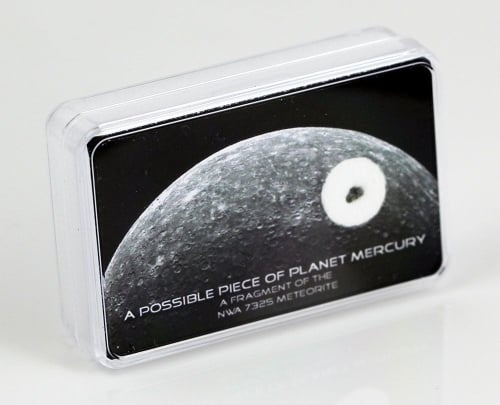
Mercury Meteorite NWA 7325 A Possible Piece of Mercury Very Rare
- Mercury Meteorite NWA 7325 A Possible Piece of Mercury Very Rare
- £58.75
Some scientists say that this is a piece of Mercury and is consistent with observations of the small planet's surface, but other scientists argue that the meteorite is too old to be from Mercury. The age of the meteorite is 4.56 BILLION YEARS OLD! That would have been almost immediately after our solar system sprang from the swirling disk of gas and dust around our newborn sun (can you imagine?!). The tight time frame means that the then proto-Mercury would have had only 8 million years to form, melt inside and separate into core and crust before another impact knocked off a chunk of its outer layer. That said, that’s not an impossible scenario. So overall, this is inconclusive. BUT one thing is for certain... even if this isn't from Mercury, it isn't from any other planet in our solar system... so where did it come from?!
- Weight ranges from 7-17mg
- Comes with a Certificate of Authenticity
- Comes with a Fact Sheet about the Meteorite
- Comes with a Scientific Article about the Meteorite
Physical characteristics: A group of 35 very fresh, dark greenish stones (total 345 g), several of which have partial remnant chartreuse-colored fusion crust. This material is notable for the characteristic "frosty" luster of the plagioclase and bright green color of the clinopyroxene.Petrography: (A. Irving and S. Kuehner, UWS): The studied specimen has an overall plutonic igneous (possibly cumulate) texture. It is a medium-grained aggregate of Al-Cr-bearing diopside, calcic plagioclase and lobate (possibly resorbed) grains of forsterite, with accessory Cr-bearing iron sulfide (probably troilite), very sparse ferrochromite, kamacite and taenite, and rare eskolaite (associated with Cr-Fe sulfide). In thin section the untwinned plagioclase is birefringent, but the levels of birefringence are less than normal and variable on a fine scale (suggesting the existence of compositional and/or structural microdomains); there also are sparse vesicles (suggesting at least partial melting). The pyroxene exhibits at least two sets of polysynthetic twin lamellae, which resemble those produced by moderately high shock.
Geochemistry: Clinopyroxene (Fs1.1-2.6 Wo45.1-44.5, FeO/MnO = 12-21, Al2O3 = 2.6-2.8 wt.%, Cr2O3 = 1.0 wt.%), plagioclase (An88.1-89.2Or0.0), olivine (Fa2.7-2.8, FeO/MnO = 30-36, CaO = 0.27-0.32 wt.%, Cr2O3 = 0.32-0.35 wt.%). Bulk composition (G. Chen, UAb): analyses of representative bulk wire-saw cutting dust by ICP-MS gave: (in ppm) La 0.15, Ce 0.34, Nd 0.16, Sm 0.05, Eu 0.58, Gd 0.05, Hf 0.44, Th 0.27. Oxygen isotopes (K. Zeigler, UNM): laser fluorination analyses of acid-washed subsamples gave, respectively δ17O = 3.214, 3.670, 3.249; δ18O = 7.566, 8.204, 7.957; Δ17O = -0.781, -0.662, -0.952 per mil [for TFL slope of 0.528].
Classification: Achondrite (ungrouped). The combination of highly magnesian mafic silicates and highly calcic plagioclase with chromium-bearing sulfides is unique among achondrites, and the specimen is highly depleted in most trace elements.
THE STORY
In early 2012, a nomad in the western Sahara spotted some green stones scattered on the sand. Knowing that the empty desert was a good place to find rocks from space, and that meteorite dealers would pay good money for them, he picked up about three dozen that looked related.
By spring all 345 grams of them were for sale in Erfoud, Morocco. A known meteorite dealer from Germany was cruising the markets, spotted the stones and asked about them. The seller said he thought they were from a Martian meteorite. But the dealer argued that they couldn’t be from a meteorite of any type because of their bizarre, lustrous, emerald colour.
Thus began a scientific detective story to unravel the mystery of NWA (for North West Africa) 7325. And while the story isn’t finished yet, one thing is clear: The main character is a very interesting something. It may be the first meteorite ever to hail from the planet closest to the sun.
To have any meteorite formally classified, a dealer must donate 20 grams or 20 percent of the sample to a scientific institution. The meteorite dealer had worked before with Anthony Irving, a meteorite expert at the University of Washington in Seattle. So he shipped some stones to Irving, who got to work studying their mineralogy and sharing samples with scientists for other tests.
For his part, Irving doesn’t care exactly what NWA 7325 ends up being. “It’s an unsolved mystery,” he says. “That’s the fascination with meteorites, which is why I like doing this.”
NWA 7325 has several curious characteristics. It contains lots of magnesium, which most meteorites don’t have, and almost no iron, which most meteorites do. Its pale hue — different from the dark gray or black of many meteorites — suggests it came from the outer portion of a celestial body that separated into layers the way planets do, with a dense, hot core surrounded by a much lighter crust.
Likely candidates would be rocky planets Mercury, Venus or Mars. Scientists rule Venus out because its thick atmosphere burns up any incoming (or outgoing) rocks. Mars is also out of the running. Researchers know of 67 meteorites from Mars, but NWA 7325’s ratio of oxygen isotopes, each with varying numbers of neutrons in its atomic nucleus, is nothing like the oxygen ratios from known Martian meteorites.
“We’re dealing with a place that we didn’t know about before,” says Irving. “It’s not any of the usual suspects.”
Suspect Mercury
In theory, it would be tough to get a rock from Mercury to Earth because the rock would have to spiral outward in the solar system, away from the sun’s immense gravitational pull. (Mercury is 58 million kilometers from the sun; Earth is 150 million kilometers from the sun.) But in 2009, a pair of Canadian researchers did some recalculating. They found that because of the sun’s strong pull, rocks smashing into Mercury would be moving very fast. So fast, in fact, that debris kicked up from their impact might also be moving fast enough to sail all the way to Earth. The scientists say that roughly 2 to 5 percent of rocks leaving Mercury at high speeds (faster than 9 kilometers per second) might reach Earth within 30 million years, an estimate about 10 to 100 times higher than previously thought.
Tests on the weird green rock also support the idea that it may have made the trip from Mercury, says Irving, who presented his theory in March at the Lunar and Planetary Science Conference in The Woodlands, Texas. Irving lent his samples to Benjamin Weiss, a magnetics expert at the Massachusetts Institute of Technology in Cambridge. In a stroke of bad luck, the intrinsic magnetic fields of all of the rocks except one had been erased by the common kitchen magnets that Moroccan meteorite hunters carry around. But Weiss was able to test the one unaltered rock, and it turned out to have the lowest magnetic intensity ever measured in any meteorite—a magnetism that matches Mercury’s modern field almost exactly, Irving says.
The magnetism, the low iron content and the high magnesium content all suggest that Mercury is the meteorite’s original home. But other scientists aren’t nearly as confident as Irving. They point to other problems with NWA 7325’s chemistry. First, NASA’s MESSENGER spacecraft recently discovered that Mercury has quite a bit of sulfur on its surface, but NWA 7325 doesn’t contain sulfur-rich minerals to the degree that would be expected were it from Mercury, says Shoshana Weider, a geochemist at the Carnegie Institution for Science in Washington, D.C. The rock also has different levels of titanium and calcium than Mercury has, plus large amounts of a chromium-rich version of the mineral pyroxene.
The chemical evidence doesn’t quite add up, says Timothy McCoy, a meteorite expert at the Smithsonian’s National Museum of Natural History in Washington, D.C. He thinks NWA 7325 could belong to a class of meteorites known as primitive achondrites, which contain chromium-rich pyroxene and are low in iron. These meteorites are thought to be the remains of protoplanets that formed in the early solar system, separated out a crust and core, and then were shattered into oblivion by some impact.
Another potential problem: NWA 7325 is ancient. Geochemists at Australian National University in Canberra, working with Irving, tested lead isotopes left behind in the rock by the radioactive decay of uranium. From that they could back-calculate how long it had been since the meteorite formed, and they came up with an age of 4.56 billion years. That would have been almost immediately after the solar system sprang from the swirling disk of gas and dust around the newborn sun. The tight time frame means that the proto-Mercury would have had only 8 million years to form, melt inside and separate into core and crust before another impact knocked off a chunk of its outer layer. That’s not an impossible scenario, says Yuri Amelin of ANU, who will report on the dating work in July at the Meteoritical Society meeting in Edmonton, Canada.
But the timing also opens the possibility that NWA 7325 could have come from a small asteroid that cooled off quickly in the early solar system, says Richard Carlson, a meteorite expert at Carnegie. It would not necessarily have had to come from something quite as large as Mercury, he says.
Irving has a comeback for arguments about the rock’s age; he points out that the famous Martian meteorite ALH84001 may be as old or even older. “If you can do it on Mars, you can do it on Mercury,” he says.
Further studies might help scientists choose among the possibilities. Thomas Sharp, a geochemist at Arizona State University in Tempe, is looking for physical evidence that NWA 7325 was shocked by an impact at some point in its past. Research has not yet turned up a mineral called maskelynite, a glassy substance that forms in rocks that have been shocked by high pressures and high temperatures, Sharp says. But the meteorite does show hints in some places of having melted and recrystallized, which could indicate more about the conditions under which it was knocked off from its parent body.
In the end, there may be no way to tell definitively whether or not NWA 7325 is from Mercury. At least not yet. When scientists find a rock that they think is from the moon, they can test it against the lunar rocks brought back by Apollo astronauts. Possible Martian meteorites can be tested against ones known to be from Mars because of the air trapped within them. But an equivalent test for Mercury could only be done if a spacecraft were to bring back a sample from the planet’s surface.
Very Rare Piece One You Just Have To Own Very Limited!
Free Delivery